|
Title |
: MACIB project (end-line) evaluation |
|
Client |
: 05 MACIB clients (Tan Phat Loi, Tai Thinh Phat Farm, Hoa Nho, Hoa De, Toan Thang) |
|
Country |
: Vietnam |
|
Project number |
: 24ATVN-9764 |
|
Assignment number |
: EVA 23388 |
|
Period |
: 21 April to 12 June 2026 |
|
Cooperative advisor (CA) |
: Le Thi Thu Hien, Tran Quang Dieu |
Introduction
Agriterra is a mission‑driven organization committed to strengthening farmer cooperatives across Africa and Asia. In Vietnam, Agriterra implements the Making Aquaculture Cooperatives Bankable and Inclusive (MACIB) program (funded by the Dutch government) from 15 March 2024 until 15 Mar 2026 (later extended to 30 Jun 2026), focused on professionalizing aquaculture (shrimp) cooperatives in Mekong River Delta (in particular Can Tho, Vinh Long and Ca Mau). The project equips smallholder shrimp farmers with tools to be financially independence, achieve quality standards, and access high-value markets by enhancing cooperative governance, financial literacy, and climate-smart practices.
During the Mid-term review conducted in mid-2025, the project was evaluated on its foundational milestones, including the development of strategic business plans for 2025–2029 and the establishment of market linkages through MoUs with industry leaders like Skretting Vietnam and Minh Phu Seafood Corporation. The MTR provided actionable recommendations for project refinement. The second half of the project’s life cycle was dedicated to scaling these interventions and implementing the MTR’s strategic adjustments
Background of the Assignment
After more than two years of implementation, and as the project approaches its end date (30 June 2026), Agriterra is seeking to conduct an impactful end-line evaluation. The findings and recommendations from this evaluation will be used to report to the project’s donor and share lessons learned with relevant stakeholders. A core component of this review is assessing the continuity and adaptability of the project post-MTR. Specifically, the evaluators will analyze how Agriterra implemented the recommendations gathered during the Mid-Term Review.
Because this type of evaluation falls outside of Agriterra’s core expertise, and to ensure objectivity, Agriterra will engage local Vietnamese experts with proven experience in this field to carry out the assignment.
Main objective
To conduct a comprehensive final evaluation of the project’s overall impact, effectiveness, relevance, and sustainability, while verifying the successful integration of strategic adjustments recommended during the mid-term review.
Specific objectives
To conduct an independent evaluation of the project’s impact, effectiveness, and sustainability; to synthesize lessons learned; and to provide recommendations for improvement and scaling up the project model for relevant stakeholders. Specific evaluation aspects include:
- Project Effectiveness: Results achieved compared to the set objectives and indicators;
- Project Relevance: Alignment with the actual needs of the beneficiaries and local development policies;
- Impact: Tangible and intangible values delivered by the project to the beneficiaries and the local community;
- Sustainability: The long-term viability of the project models and the project’s approach;
- Lessons Learned and Recommendations: Suggestions for sustaining project results to improve efficiency, impact, and the potential for replication
Expected Results (all reports, presentation should be presented in English)
- Inception Report: Outlining the final evaluation methodology, including tools to measure MTR recommendation compliance.
- End-Line Findings Presentation: A stakeholder workshop presenting final outcomes.
- Comprehensive End-Line Impact Report: A detailed document capturing project outcomes, the execution of MTR recommendations, and final impact data.
- Sustainability Handover Plan: A clear roadmap for the 05 MACIB clients to maintain momentum post-project.
Evaluation Methodology
We proposes that the independent consultant utilize participatory methods involving stakeholders, including the analysis of primary and secondary data from the following sources:
- Primary Data Sources: Individual interviews and Focus Group Discussions (FGDs) with stakeholders, including beneficiaries, Agriterra’s project team, local government officials, and implementing partners.
- Secondary Data Sources: Project application, MTR report, updated PBI data, relevant policies, other documents developed by the Project, partnership agreements, etc.
Assignment details
- Composition of the Agriterra assignment team
- Le Thi Thu Hien, SCA (technical lead)
- Tran Quang Dieu, CA (for logistic support)
- Local external experts: to be recruited
Duration of the assignment: 21 Apr – 12 Jun 2026, with tentative fieldwork between 18 to 24 May 2026.
Tentative programme (to be finalised later)
|
Day |
Date |
Program |
Available |
|
|
21 April |
Preparations (consultant recruitment, document literacy, tool development, logistics arrangement, etc…) |
Agriterra |
|
Mon |
18 May |
Arrival Can Tho city |
Assignment team |
|
Tue to Sat |
19 May to 23 May |
Field work (details to be developed later) |
Assignment team |
|
Sun |
24 May |
Return home |
Assignment team |
|
|
28 May |
Submission of draft report |
LC |
|
|
5 Jun |
Response to feedback from PMEL team and/or donor |
Assignment team |
|
|
12 Jun |
Report finalized and submitted |
LC |
|
Total |
22 days max |
|
|
Logistics and support
Agriterra will provide logistical support.
Application and selection process
Interested consultants are invited to submit a complete application package. Application should include:
- Cover letter: Indicating the applicant’s interest in the assignment, highlighting relevant experience, and outlining suitability for the role.
- Technical proposal: Presenting the proposed methodology, tools, workplan to carry out the tasks and expected results outlined in the ToR.
- Financial proposal: Including the daily rate in VND (inclusive of taxes), with a clear breakdown of estimated costs (proposed consultant rate, field cost, etc).
- Updated CV(s): Providing detailed qualifications and professional experience of the consultant. Examples of similar past assignments should be attached.
Qualifications required
- Proven experience in project end-line evaluation.
- Strong background in evaluation methodologies
- Experience working with farmer cooperatives and participatory approaches.
- In-depth knowledge of Mekong Delta aquaculture (shrimp)
- English proficiency required for reporting and meeting with donor (when required).
Submission guidelines:
- All application documents must be in English.
- Please submit the full package by email with the subject line: “Consultant – MACIB project end-line evaluation”
- Email submissions should be sent to: [email protected], with cc: [email protected]
Selection process:
- Only shortlisted candidates will be contacted and invited for an interview.
- The closing date for application is 5pm, 3 May 2026.
Agriterra, for cooperatives
We are a purpose-driven organisation, aimed at strengthening farmer cooperatives in 13 countries in Africa and Asia. Agriterra’s wheel of impact depicts how strong farmer cooperatives contribute to societal development and the relevance to many of the Sustainable Development Goals of the United Nations.
Positively impacting farmer cooperatives is at the heart of our identity and is reflected in our legal entity as a Dutch non-profit foundation.
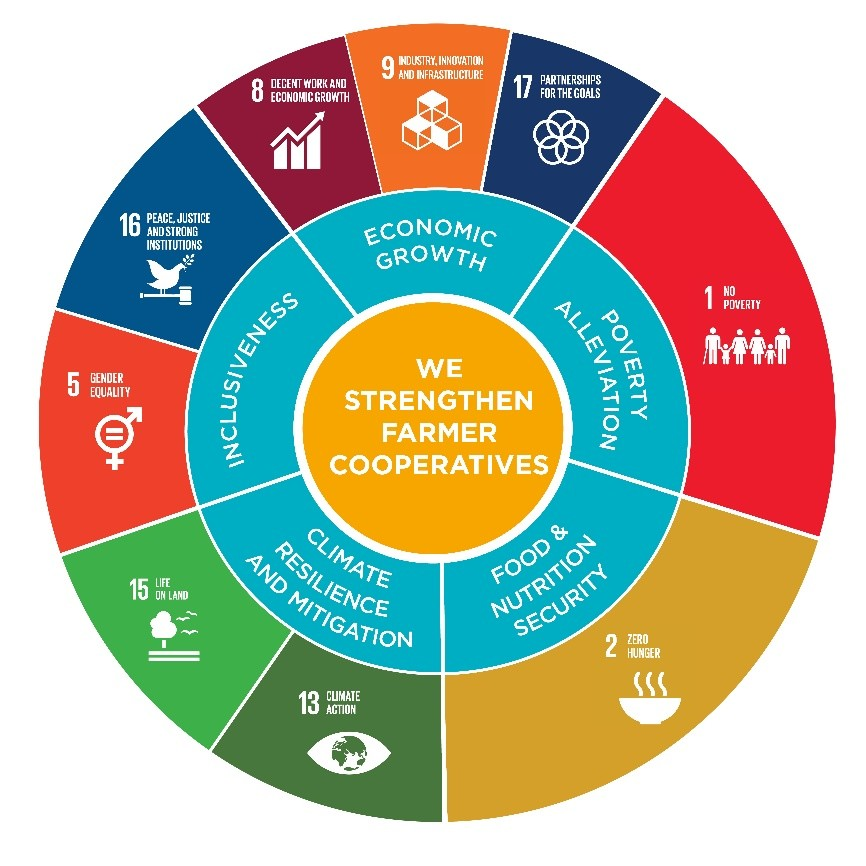
Agriterra provides high quality and hands-on advice, training and exchange services to farmer cooperatives with maximum impact to support dynamic, economic and sustainably strong and productive rural areas. We draw on a century of cooperative knowledge in the Netherlands shared through our extensive network in the Dutch agri-food sector. These Agripool experts from farmer organisations across the world work with Cooperative advisors from our country offices, supported by staff teams in the Netherlands.
In 2022 Agriterra worked together with 579 farmer organisations, trained 8,989 people and 3,808,366 farmers were reached.